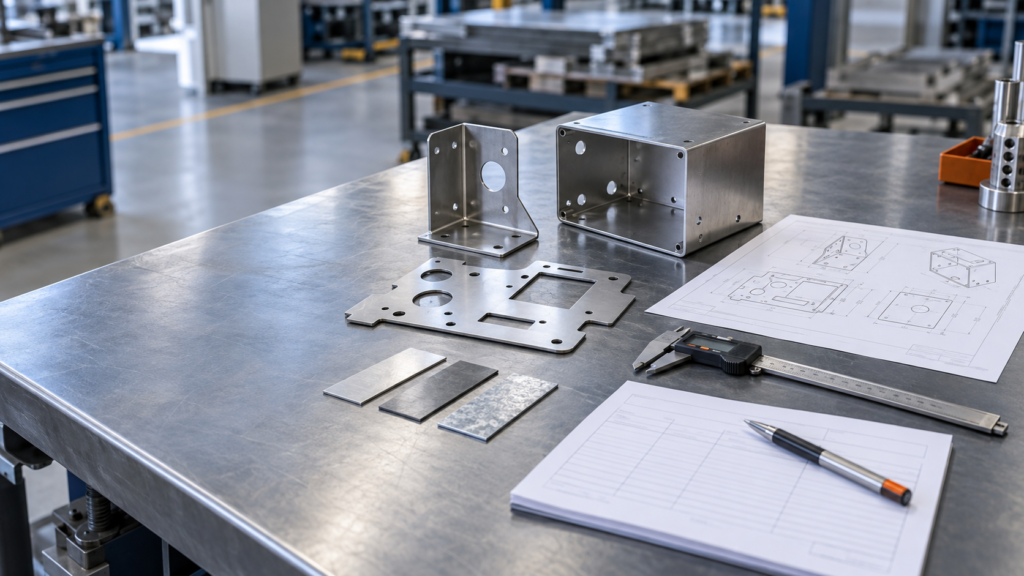
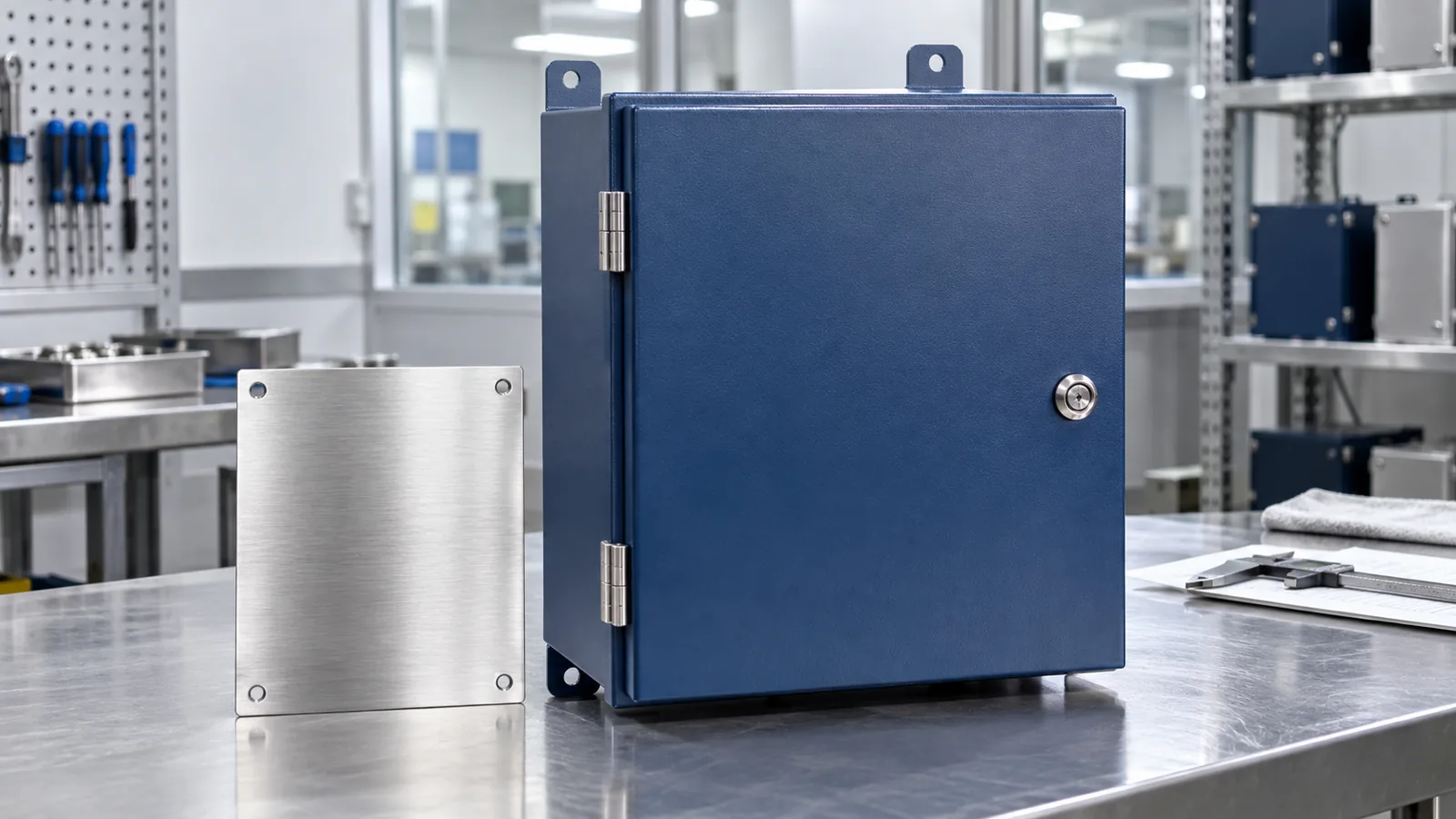
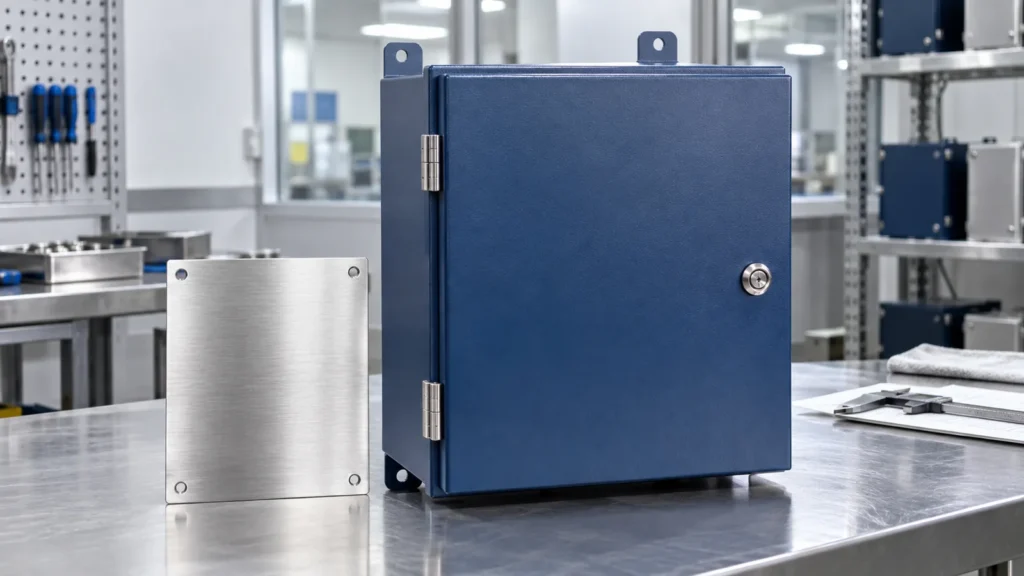
Can you powder coat stainless steel? Yes. Stainless steel parts can receive a durable and consistent powder-coated finish when the surface is cleaned, prepared and cured correctly.
Powder coating stainless steel is commonly considered for electrical enclosures, control cabinets, equipment panels, brackets, machine covers and other custom-fabricated components. It can add color, reduce glare and create a more uniform appearance across an assembled product.
However, the quality of the finished coating depends on much more than the powder itself. Surface preparation, part geometry, masking, grounding, curing and inspection must all be considered before production begins.
Why Powder Coat Stainless Steel?
Stainless steel already provides good corrosion resistance, so coating it is not always necessary. Buyers normally choose powder coating when a project requires an appearance or surface characteristic that bare stainless steel does not provide.
Common reasons include:
- Matching a company or equipment color
- Creating a consistent appearance across an assembly
- Producing a matte, gloss or textured surface
- Reducing reflections from bright stainless steel
- Adding protection against handling and light abrasion
- Covering normal appearance differences between welded and formed areas
- Matching stainless steel components with coated carbon steel panels
A powder-coated surface can also make equipment easier to integrate into an existing product line.
The coating must still be selected for the intended environment. Powder coating does not automatically make every stainless steel component suitable for outdoor, marine, chemical or high-temperature service.
When Should Stainless Steel Remain Uncoated?
Bare, brushed or passivated stainless steel may be a better choice when its natural appearance, cleanability or corrosion performance is the main reason for choosing the material.
Examples include:
- Food-processing equipment
- Pharmaceutical and hygienic applications
- Frequently washed components
- High-temperature equipment
- Electrical grounding surfaces
- Conductive mounting points
- Products where scratches would be highly visible
- Decorative products requiring a brushed metal appearance
A coating can be damaged during installation or service. If the powder-coated surface is scratched, the exposed substrate will still depend on the corrosion resistance of the selected stainless steel grade.
For this reason, powder coating should not be used to justify changing from 316 stainless steel to a lower-cost grade without an engineering review.
Surface Preparation Is the Critical Step
Surface preparation is one of the most important parts of stainless steel powder coating.
Newly fabricated stainless steel may contain:
- Cutting fluids
- Bending lubricants
- Fingerprints
- Polishing compound
- Welding residue
- Heat tint
- Grinding dust
- Protective-film adhesive
- Contamination from handling equipment
If these contaminants remain on the surface, they can cause weak adhesion, fisheyes, pinholes, bubbles or inconsistent texture.
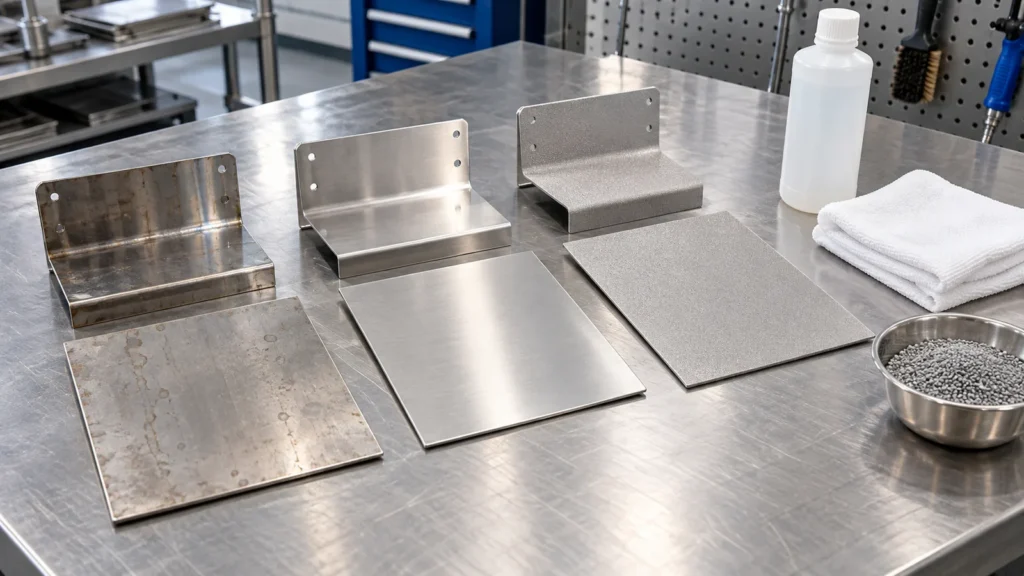
The preparation process may include degreasing, rinsing, controlled mechanical abrasion, blasting with suitable clean media or a compatible chemical pretreatment. The correct method depends on the stainless steel grade, original surface condition, coating system and required performance.
Equipment used to prepare carbon steel should not automatically be used on stainless steel. Carbon steel particles can become embedded in the stainless surface and later appear as corrosion spots.
Welded areas also require careful review. Weld spatter, heat discoloration and rough grinding marks may remain visible after coating. Powder coating creates a uniform color, but it does not reliably hide dents, distortion or deep surface defects.
If cosmetic welds must be ground smooth, that requirement should be marked on the drawing.
How Is Stainless Steel Powder Coated?
A typical stainless steel powder-coating process includes the following steps.
1. Review the Material and Finish Requirements
Before fabrication begins, confirm:
- Stainless steel grade
- Material thickness
- Required color
- Gloss level
- Surface texture
- Cosmetic surfaces
- Masked areas
- Coating performance requirements
- Acceptable hanging points
- Required inspection or testing
The drawing should identify the surfaces that customers will see after assembly.
2. Complete the Main Fabrication Work
Cutting, punching, bending and most welding operations should normally be completed before coating.
Burrs and sharp edges should be removed. Weld spatter should also be controlled because powder may highlight rather than hide severe surface irregularities.
Only welds requiring a specified cosmetic finish should be ground smooth. Unnecessary grinding increases production cost and can distort thin panels.
3. Clean and Prepare the Surface
Oil, dust, polishing residue and other contamination must be removed.
If the preparation process uses rinsing or chemical treatment, the parts must be dried completely before powder application. Folded seams, closed tubes and overlapping components can retain cleaning liquid and later create defects during curing.
Drainage or ventilation features may be required for products with closed or partially closed sections.
4. Mask Functional Areas
Some surfaces may need to remain uncoated, including:
- Threads
- Electrical grounding points
- Conductive contacts
- Bearing surfaces
- Precision holes
- Hardware installation areas
- Gasket interfaces
- Mating surfaces
- Selected visible stainless steel areas
Masking requirements should appear clearly on the drawing. A general note such as “mask where required” leaves too much room for interpretation.
5. Ground and Hang the Part
Powder coating uses electrostatic attraction. The stainless steel component must be grounded correctly so the charged powder particles deposit evenly.
Every part also needs a hanging point. The hanger may leave a small contact mark, so it should be positioned on a concealed or noncosmetic surface.
Large or heavy enclosures may require several hanging points to remain stable during spraying and curing.
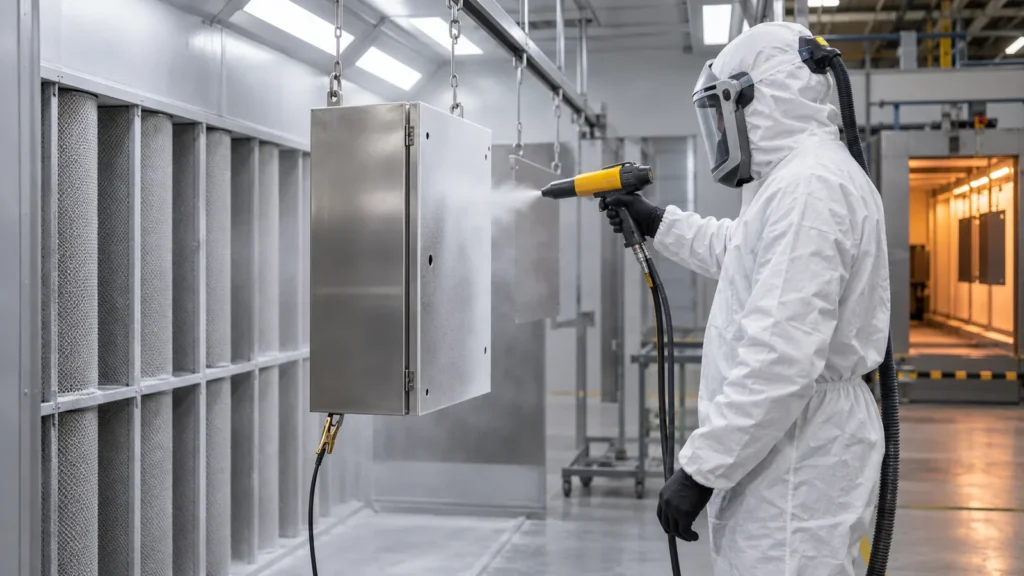
6. Apply the Powder
The operator sprays electrostatically charged powder onto the grounded component.
Deep recesses, narrow channels and tight inside corners can be difficult to cover evenly. These locations may experience a Faraday cage effect, where the charged powder does not enter the corner as easily as it reaches an open surface.
Part orientation, grounding, spray technique and product geometry all influence coating coverage.
Applying more powder is not always the solution. Excessive buildup can create an uneven appearance, interfere with assembly and increase the risk of surface defects.
7. Cure the Coating
The coated component is placed in an oven so the powder melts, flows and cures.
The required curing schedule is normally based on the temperature reached by the metal, not only the oven-air temperature. Thick brackets and thin panels may reach the required metal temperature at different rates.
The curing cycle should follow the technical requirements of the selected powder.
After curing and cooling, the manufacturer can inspect appearance, color, gloss, coverage, masked areas and coating thickness.
Can Both 304 and 316 Stainless Steel Be Powder Coated?
Both 304 and 316 stainless steel can be powder coated.
Type 304 is widely used for indoor equipment, general enclosures, cabinets, panels and fabricated components. Type 316 is often selected for applications involving chloride exposure, coastal environments or more demanding corrosion conditions.
The coating process does not remove the performance differences between these materials.
If an edge, drilled hole or scratch exposes the substrate, the stainless steel grade continues to affect corrosion resistance. The drawing and bill of materials should therefore identify the exact stainless steel grade instead of stating only “stainless steel.”
A powder coating may provide an additional barrier, but it should not be used to justify a lower substrate grade without considering the service environment.
Design Details That Affect Coating Quality
Good coating quality begins with part design.
Inside Corners
Narrow inside corners are harder to coat evenly. More open and accessible geometry can improve powder coverage and reduce the risk of thin areas.
Holes and Threads
Powder coating adds thickness to holes and surrounding surfaces.
Close-tolerance holes, threaded holes and locating features may require masking. Drawings should state whether an important dimension applies before or after coating.
Overlapping Panels
Powder may bridge a narrow gap without sealing the joint.
If the assembly needs protection against water or dust, specify the necessary gasket, sealant, weld or tested enclosure requirement separately. Powder coating should not be treated as a substitute for enclosure sealing.
Drainage and Ventilation
Closed profiles, folded seams and welded cavities may trap cleaning liquid or air. Properly positioned drainage and ventilation holes can reduce this risk.
The location of these holes should be reviewed so they do not weaken the assembly or allow water to enter the finished product.
Hanging Points
Every component needs a location for hanging and grounding. The accepted location should be placed away from important cosmetic surfaces.
If the customer does not identify an acceptable hanging point, the manufacturer may need to select one based on the production process.
Installed Hardware
Pressing self-clinching hardware into a finished panel can crack or chip the coating.
The manufacturing sequence must determine which hardware is installed before coating, which areas require masking and which components should be installed during final assembly.
Common Powder-Coating Defects
Poor Adhesion
Poor adhesion may be caused by surface oil, polishing residue, insufficient preparation or an incompatible pretreatment.
A documented cleaning and preparation process is the main control.
Pinholes and Bubbles
Moisture, trapped gas and contamination can escape during curing and leave small holes or bubbles in the coating.
Welded seams, closed features and folded sections should be reviewed before finishing.
Uneven Coating Thickness
Deep corners, poor grounding, incorrect part orientation or inconsistent spray distance can create thin and heavy coating areas.
When coating thickness is functionally important, it should be measured at agreed inspection locations.
Color and Gloss Variation
Powder batch, coating thickness, curing conditions and substrate texture can influence the final color and gloss.
For highly visible equipment, the buyer and manufacturer should approve a physical sample before mass production.
A digital color image on a computer screen is not a reliable replacement for an approved sample.
Chipping Around Hardware
Installing hardware or forcing components together after coating may damage the finish.
Hole clearances, hardware sequence and final assembly requirements should be considered before production begins.
Dust or Surface Contamination
Dust in the preparation, spraying or curing area can produce visible particles in the finished surface.
Cosmetic requirements should define which surfaces are critical and the viewing conditions used during inspection.
Does Powder Coating Improve Corrosion Resistance?
Powder coating creates a barrier between the environment and the stainless steel substrate. When the coating remains intact and the surface has been prepared correctly, it can provide additional protection.
However, corrosion performance depends on the complete material and coating system.
Important factors include:
- Stainless steel grade
- Surface preparation
- Coating chemistry
- Coating thickness
- Edge coverage
- Curing conditions
- Assembly design
- Exposure environment
- Product maintenance
- Damage during transportation or installation
Salt-spray testing may be useful for certain specifications, but the number of test hours should not automatically be treated as the expected service life of the finished product.
The test method and acceptance criteria should reflect the real application.
Does Powder Coating Stainless Steel Cost More?
The cost depends on more than the total surface area.
Important cost factors include:
- Part dimensions
- Order quantity
- Surface condition
- Cleaning requirements
- Preparation method
- Number of masked holes
- Number of threaded features
- Custom powder color
- Gloss and texture
- Coating thickness
- Product weight
- Rack and oven capacity
- Inspection requirements
- Packaging protection
A complex enclosure with numerous threads, electrical contact points and cosmetic surfaces requires more preparation and masking than a simple stainless steel bracket.
Custom colors can also increase costs for low-volume orders because of powder minimums, cleaning and production setup.
Providing complete drawings allows the manufacturer to evaluate fabrication and finishing requirements together.
What Should You Include in an RFQ?
For a more accurate quotation, provide:
- 3D CAD files
- Controlled 2D drawings
- Stainless steel grade
- Material thickness
- Prototype and production quantities
- RAL or another color reference
- Required gloss level
- Surface texture
- Powder type, if specified
- Areas requiring masking
- Cosmetic surface requirements
- Coating thickness requirements
- Inspection or testing requirements
- Packaging requirements
- Intended operating environment
If you do not know which coating system to specify, explain where and how the product will be used. The manufacturer and coating supplier can then evaluate a suitable finishing route.
Review Zhen Pai’s manufacturing capabilities:
See the connected fabrication workflow:
Frequently Asked Questions
Will Powder Coating Stick to Stainless Steel?
Yes. Powder coating can adhere to stainless steel when the surface is cleaned and prepared for the selected coating system.
Applying powder directly over oil, polishing residue or an unsuitable surface may result in poor adhesion.
Can Brushed Stainless Steel Be Powder Coated?
Yes. Brushed stainless steel can be powder coated, but the surface still requires appropriate cleaning and preparation.
The coating will cover most of the visible brushed appearance, so buyers should not expect the original grain to remain visible.
Can Powder-Coated Stainless Steel Be Used Outdoors?
It can be used outdoors when the stainless steel grade, surface preparation and powder system are suitable for the environment.
Outdoor use, UV exposure, coastal conditions and contact with chemicals should be identified in the RFQ.
Should Stainless Steel Threads Be Powder Coated?
Threads are normally masked unless the design specifically allows for coating thickness.
Excess coating can prevent correct assembly or affect fastener engagement.
Can Powder Coating Hide Welding and Grinding Marks?
Powder coating can create a consistent color, but it cannot reliably hide deep grinding marks, dents, excessive weld buildup or distortion.
Cosmetic preparation requirements must be specified separately.
Can Stainless Steel Be Recoated?
In some cases, an existing coating can be removed and the component recoated. The feasibility depends on the previous coating, part geometry, material condition and removal process.
Recoating should be evaluated before assuming that the original component can be reused.
Final Answer
Can you powder coat stainless steel? Yes. Stainless steel can receive a durable and consistent powder-coated finish when the surface is cleaned, prepared, grounded, coated and cured correctly.
The product design should also account for coating thickness, masking, hanging points, drainage, inside corners, hardware installation and final inspection.
If you need a custom stainless steel enclosure, cabinet, panel, bracket or welded assembly, send Zhen Pai your drawings, quantities, material grade and finishing requirements for review: