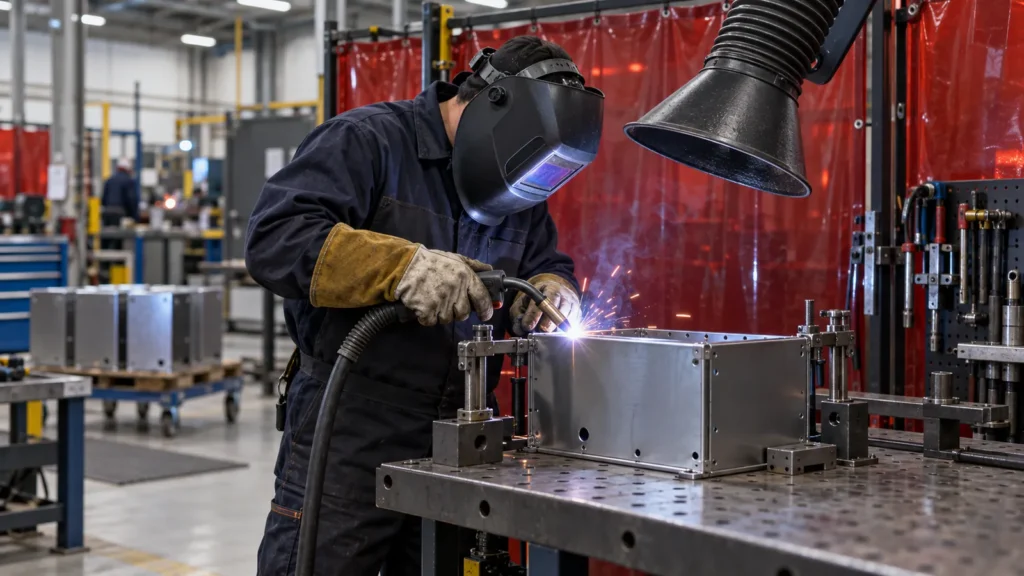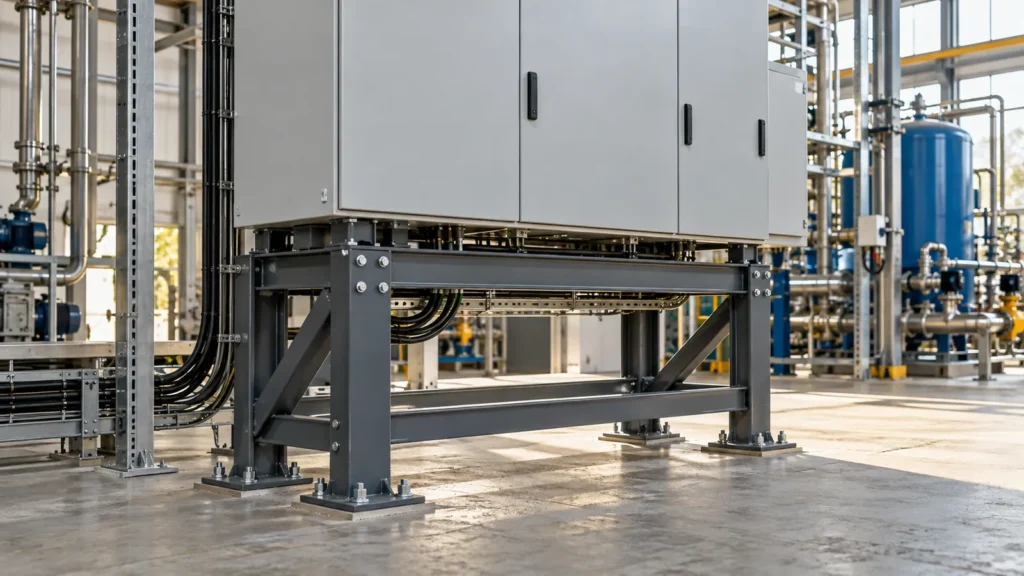
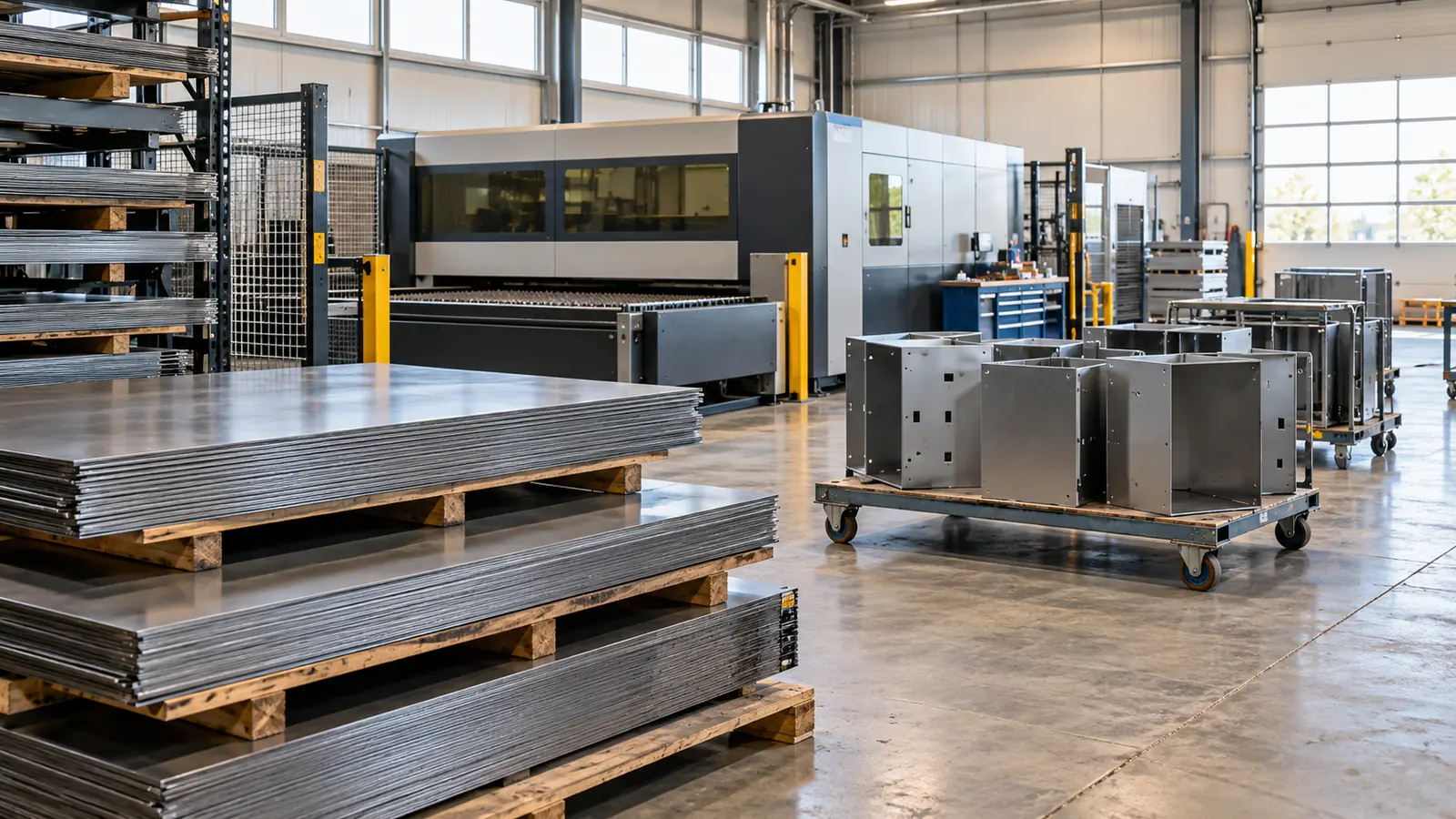
A rectangular cover and a perforated bracket can begin as the same steel sheet and call for very different production plans. Sheet steel cutting should be selected around the component’s geometry, edge requirements, next operation, and order quantity. A list of machine types is only useful once those requirements are clear.
For a buyer, the best comparison is the route from stock to accepted part. Cutting time is one item in that route. Setup, handling, deburring, forming, hole finishing, and inspection can change the result substantially. A quick first operation is of little value if it leaves unnecessary work for the next one.
Read the drawing before naming a process
Start with the outside contour. Is it a rectangle, a shape with several notches, or a long curved profile? Then look inside it. A few clearance holes present a different job from a dense ventilation pattern, narrow slots, or holes intended to locate another component.
Material needs more definition than “steel.” Provide the grade, thickness, and supplied surface condition. Coated sheet and bare sheet may require different handling and edge treatment. If the part will be painted later, identify the finish requirements without assuming that paint will conceal a rough edge or repair a distorted feature.
Quantity also needs context. A prototype order may tolerate a route that becomes inconvenient in repeat production. Conversely, a recurring design with uncertain annual demand may not justify the same tooling decision as a stable production order. Share the actual order quantity, expected repeats, and likelihood of a drawing change.
These details allow a meaningful conversation about ZhenPai’s cutting and punching services. They also prevent a quote from being built around an assumption that the buyer never intended.
Where laser cutting earns its place
Laser cutting is worth considering when a component has a changing or detailed contour, a mix of holes and cutouts, or several related variants. A cutting program can follow those features without requiring a dedicated tool for each outside shape. That flexibility is useful during design changes, provided each released revision is controlled properly.
Look at the features rather than stopping at “laser cut.” Small openings, close-spaced cuts, acute details, and long slender sections deserve review for the selected steel and thickness. Edge appearance and the amount of subsequent finishing should also be agreed. The actual process setup matters more than a broad promise that every laser-cut edge is ready for every use.
For example, an instrument cover with connector openings and an irregular mounting outline might be a sensible laser candidate. The supplier can review the entire flat profile together. The locating features still need their own acceptance requirements, and any openings near future bends need to be checked in the formed condition.
It is usually clearer to submit the intended finished geometry and let the manufacturer prepare the production program. Confirm the file convention at quotation, especially if a buyer has already altered a profile for a presumed cutting allowance.
Punching suits repetition, but examine the whole pattern
A panel filled with repeated holes can point toward punching. So can a design that uses features compatible with available tooling. It is worth asking how many tool changes the job needs, whether the required shapes are already supported, and what happens when the pattern reaches a formed edge.
TRUMPF describes punching as cutting the sheet with a punch and die in a stroke; nibbling builds a contour through overlapping punches. The distinction matters on a specified edge: a contour made through successive overlapping hits should be reviewed for the resulting edge profile and any finishing needed. TRUMPF punching and nibbling
A ventilation panel provides another example. Repeated round holes may suit punching, while a nearby connector opening could require different tooling or another operation. The quantity and the pattern determine whether that combination is worthwhile. The buyer should compare the complete panel, including flatness, visible surface condition, and cut-edge requirements.
Punching also requires attention to burr direction. If the component has an exposed face, a sealing surface, or a flange that must seat closely, tell the supplier which side matters. “Deburr” by itself may not settle every functional requirement.
Shearing makes sense when the shape allows it
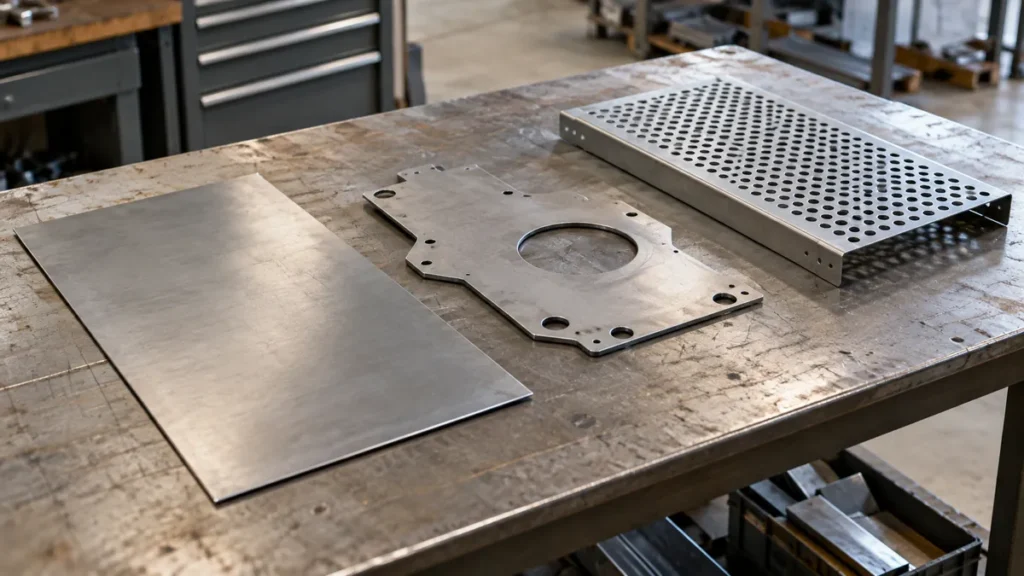
For straight-sided blanks, shearing deserves consideration before a more flexible contour process is specified. A plain rectangular strip may not need a programmed perimeter cut. Shearing can form part of a practical route when the remaining features are produced afterward.
That does not mean every rectangular component should be sheared. A finished rectangle containing many openings may be more convenient to process as one programmed job. A narrow strip may have a straightness or flatness requirement that deserves particular review. Edge condition, squareness, material behavior, and how the blank will be located at the next operation all belong in the comparison.
An internal spacer strip with two later-drilled holes can be evaluated differently from a visible enclosure panel with tightly related holes and edges. In this comparison, the strip may tolerate a simple blanking route. The panel needs the supplier to explain how the final feature relationships will be established and checked.
Confirm the supplier’s available equipment and proposed operation sequence for the project being quoted. A technically plausible route is only useful when the manufacturer can support it and has included all its stages in the quotation.
Plasma cutting needs an edge and hole conversation
Plasma is another process to evaluate where the component and available system make it appropriate, particularly when the work extends into plate. A structural profile with generous clearances has different needs from a sheet panel containing small locating holes.
Evaluate plasma against the component’s acceptance requirements. Hypertherm lists dross, cut angularity, incomplete cuts, and hole quality among the variables involved in plasma cut quality. It also notes that problems can arise from the process or from machine condition. Specify the required edge and hole condition and ask the supplier to review the proposed result. Hypertherm cut-quality guidance
If a hole must perform a locating function, establish whether it will be accepted as cut or finished separately. Ask the same question for an edge that mates closely to another part. A route with secondary finishing can be appropriate; it should appear in the quotation and inspection plan so both sides understand what is being supplied.
Compare routes using the component’s difficult features
The following questions help narrow a discussion. They are prompts for supplier review, not fixed rules about what a process can produce.
| Component requirement | Useful process discussion |
|---|---|
| Plain rectangular blank | Compare shearing with a contour-cut route and consider later feature location. |
| Frequent contour revisions | Review laser programming and revision handling. |
| Many repeated openings | Review punching tools, pattern effects, and finishing. |
| Structural profile with larger features | Evaluate suitable laser or plasma routes against the required edge condition. |
| Critical locating holes | Define acceptance after cutting or after a planned secondary operation. |
| Holes near a bend | Review the formed part, not only the flat blank. |
The last row is easily missed. A blank may be correct before forming, while its hole positions or local shape become unsuitable afterward. Include the bending requirements in the first review. If several operations are needed, compare them as a manufacturing route with clearly defined handoffs.
Before approving an order, resolve the drawing revision, edge treatment, critical dimensions, finish condition, and required inspection evidence. Then request a quotation that identifies the supplied condition. “Cut steel parts” could mean unfinished blanks or parts ready for the buyer’s assembly; those are different deliveries.
Send the drawing, material specification, quantities, and intended use through ZhenPai’s contact page. Include whether you need a flat blank, a formed component, or a part ready to install, so the proposed cutting route covers the correct scope.